BabelStone Blog
Sunday, 8 November 2009
The Ogham Stones of Cornwall and Devon
- The Ogham Stones of Cornwall and Devon
- The Ogham Stones of Wales
- The Ogham Stones of Scotland
- The Ogham Stones of the Isle of Man
- The Ogham Stones of Ireland
- The Ogham Stones of Elsewhere
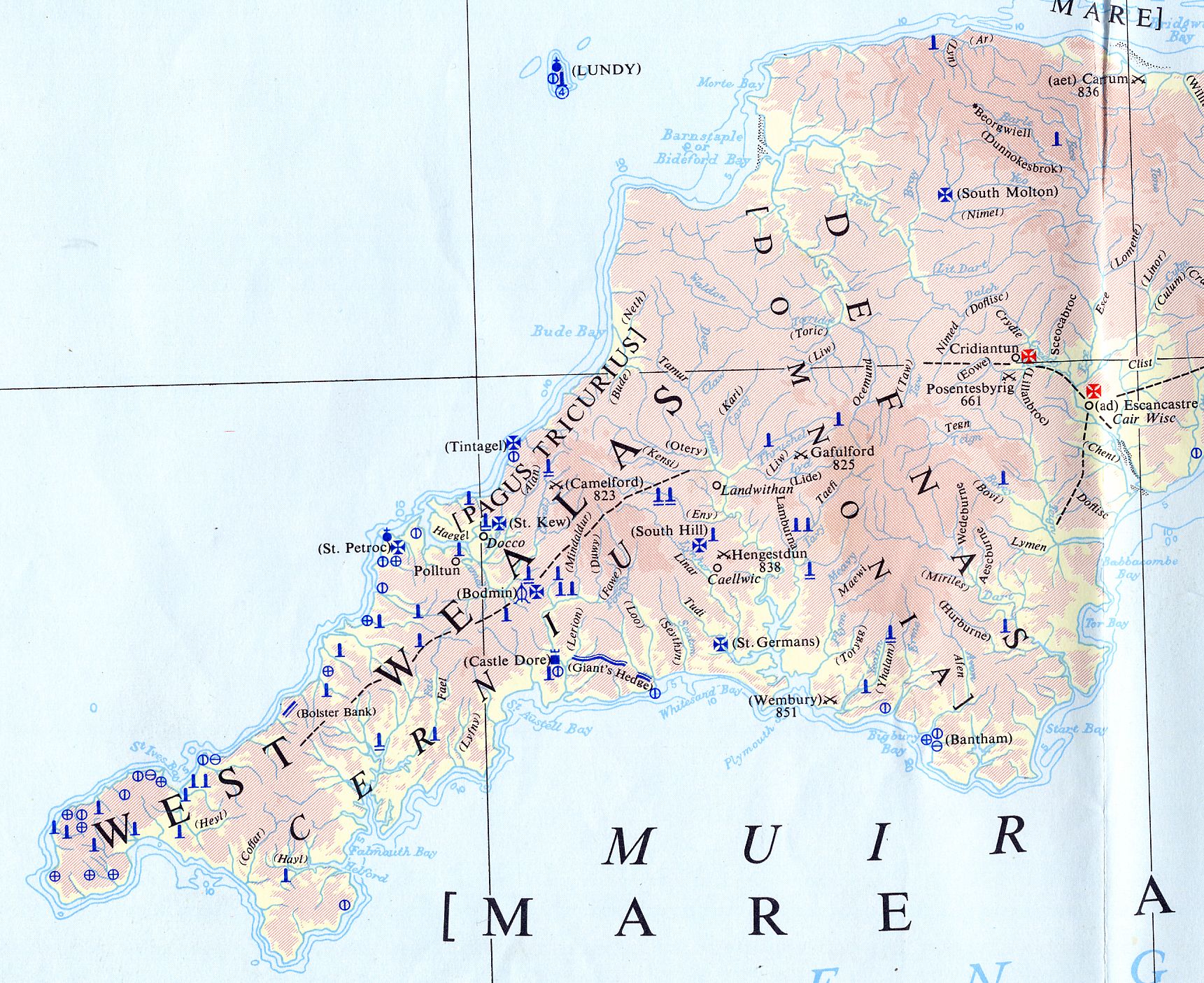
In anticipation of next week's blog post, I thought it would be useful to present a brief survey of the known Ogham stone inscriptions in Cornwall and Devon. Although the large majority of Ogham stones are found in Ireland, a number of Ogham stone inscriptions are known from Scotland, the Isle of Man, Wales, and the south-west peninsula of England (the modern counties of Cornwall and Devon), as well as a single outlier at Silchester in Hampshire. At the time that most Ogham inscriptions were made (5th century through 8th century C.E.), the south-west peninsula was occupied by the British Celtic kingdom of Dumnonia, but there were strong trading and religious ties between Dumnonia and Ireland which might explain the presence of a small number of monumental stones with Ogham inscriptions (seven certain inscriptions marked with red tags and another five dubious or unconfirmed inscriptions marked with yellow tags). It is likely that these are all that remain of a larger number of Ogham-inscribed stones in the region, but as Ogham letters along the edge of stones are easily eroded (more so than a Latin inscription on the face of the stone), some stones that now show no trace of an Ogham inscription may originally have have had one.
Location of Ogham Stones in Cornwall and Devon
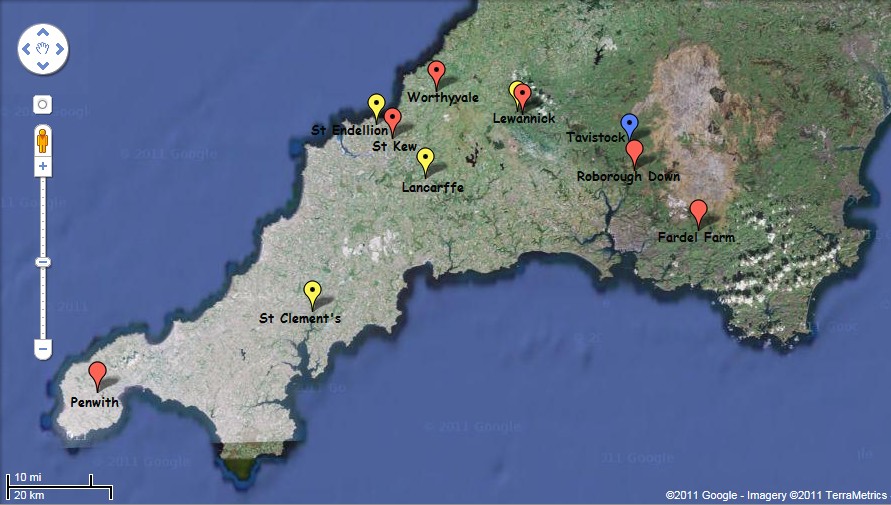
Red tags mark the sites of certain Ogham inscriptions (a dot indicates that the stone is in situ)
Yellow tags mark the sites of dubious or unconfirmed Ogham inscriptions
Blue tags mark museums or other sites where Ogham stones are held
[See also the Ordnance Survey Map of Britain in the Dark Ages (⍊ = Memorial stones with ogams)]
As can be seen from the map, the stones are mostly found in a band running from north-east Cornwall down to south-west Devon. It is possible that this distribution reflects secondary migration of Irish settlers from South Wales, in particular from the Kingdom of Dyfed (modern Pembrokeshire), where a large number of Ogham stones were erected by Irish settlers. Three of the certain Ogham inscriptions are sited in churches or churchyards, one of which (St Kew) was only moved to the churchyard after it was discovered in a nearby stream. Maybe coincidentally, two of the other three stones, that are not sited by a church, are also associated with water; one is sited on the bank of a river, and the other (now in the British Museum) was originally being used as a culvert across a stream.
A fragment of an Ogham stone found in the Penwith peninsula in autumn 2009 is by far the most westerly example of a Dumnonian Ogham stone. It is also very unusual in that the Ogham inscription is carved on the face of the stone on two artificial stemlines, rather than along the edge of the stone as is the case with the other Ogham stones from Cornwall and Devon (and also the vast majority of Ogham stones elsewhere). There is also no evidence of a parallel Latin inscription on the fragment. This stone is discussed in more detail at The Penwith Ogham Stone.
Unlike most Irish Ogham stone inscriptions, but as is also the case with almost all of the Welsh Ogham stone inscriptions, the Cornish and Devonian Ogham inscriptions are almost all bilingual and bi-script, with the text written in Latin (script and language) on the face of the stone, and in Ogham along the edge or edges of the stone (starting at the bottom, and reading up to the top). The Latin text tends to be longer than the corresponding Ogham text, forming complete sentences, whereas the Ogham text tends to merely give the name of the person commemorated by the stone. It is generally assumed that the stones commemorate Irish settlers, and so the language of the Ogham inscriptions would have been Primitive Irish, but only one of the stones is inscribed with the typical X maqi Y (X, son of Y) formula used in most Irish Ogham inscriptions, and so can be said for certain to be written in Primitive Irish. Another stone has an inscription IGENAVI MEMOR, that is linguistically ambiguous: it may simply be an Ogham transcription of the corresponding Latin inscription on the stone, INGENVI MEMORIA "the memoria of Ingenuus", or it may be a translation into Irish, with memor representing a loanword from Latin (see the entry for mebair in eDil). The other four stones only give the commemorated person's name in the Ogham script, which makes it difficult to be absolutely certain what the nominal language used for writing Ogham on these stones was, especially as some of the names are very un-Celtic. In fact, only the names on three of the six stones are Goidelic (i.e. Primitive Irish), whereas the names on the other three stones are Latin (the fragment of Ogham inscription on the newly-discovered Penwith stone is too short to read a name from it, but the presence of the unusual letter P, which is not used in Irish inscriptions, suggests that the name is probably Latin) :
- LWNCK/1 : INGENVI = Ingenuus (Latin ♂) [the name indicates a freeman who was born free ]
- LWNCK/2 : ULCAGNI = Ulcagnus (Goidelic ♂)
- STKEW/1 : IUSTI = Iustus (Latin ♂) ["just, right, equitable, fair, lawful, proper"]
- WVALE/1 : LATINI = Latinus (Latin ♂) [the name indicates a civic status intermediate between full Roman citizenship and non-citizen status]
- WVALE/1 : MAGARI/MACARI = Magarus (Uncertain ♂) or Macarius (Latin/Greek? ♂)
- TVST3/1 : ENABARR = Enabarras (Goidelic ♂) from Pr.Ir. *Etnobarros 'Birdhead' (*etnas 'bird' + barras 'top of head, scalp')
- TVST3/1 : DOBVNNI = Dobunnus (Goidelic? ♂) maybe from Pr.Ir. *dubu 'black' + ?
- FARDL/1 : SAFAQQUCI = Safaqqucus (Goidelic ♂)
- FARDL/1 : QICI = Qicus (Goidelic ♂)
The mixed Irish/Latin nature of the Dumnonian Ogham stones can perhaps best be explained as being due to the Irish immigrants being in a small minority in the Brythonic communities that they settled in, and so they had their commemoration stones inscribed in Latin (the lingua franca of the time) for the benefit of the local inhabitants, and also in Ogham in recogntion of their own cultural heritage. The TVST3/1 stone is particularly interesting in this respect, as it seems to commemorate a father and a son in two inscriptions, the father being commemorated by a simple Ogham inscription, and his son being commemorated by a much longer Latin inscription that records his occupation as a smith. This suggests that perhaps Enabarras was a first-generation Irish immigrant, but that his son Dobunnus had become Romanized, and no longer considered Irish to be his main language. The Latin names Ingenuus, Iustus and Latinus may also reflect a process of cultural acclimatization, whereby second or third generation Irish immigrants rejected the generally hypocoristic names used by their forefathers, and adopted more "civilized" Latin names.
Ogham stones are notoriously difficult to date accurately, as they normally lack any archaeological context, and because Ogham letters lack the sophistication of Latin letters it is usually hard to date them on epigraphic grounds. The Dumnonian examples have the advantage of having parallel Latin inscriptions, but even so it is hard to be certain when the stones were carved. Thomas (1994) dates them all to the 5th century, whereas Okasha (1993) dates them to any time within the 5th to the 8th centuries. My personal feeling is that the adoption of Latin names by many of those comemmorated on the stones suggests a date that is closer to the Roman period than to the Anglo-Saxon period, so I think a 5th century to 6th century date for the inscriptions is most likely, which would make them contemporaneous with the Ogham stones of South Wales.
Cornwall (Kernow)
 Lewannick Stone I (LWNCK/1)
| Site | St Martin's Church, Lewannick, Cornwall. |
| NGR | SX 2760 8070 |
| Current Location | In the churchyard, a few metres west of the lych-gate. |
| History | Discovered in 1892 by A. G. Langdon, buried on the south side of the churchyard. |
| Description | Pillar stone of reddish granite with horizontal Latin inscription in four lines, and Ogham inscription running up left edge. |
| Dimensions | 1.22 × 0.40 × 0.23 m. |
| Date | 400–799 (Okasha 1993) 500–533 (Thomas 1994) |
| Notes | Viewed 27 August 2010. The stone is situated to the left of the lych gate on the south side of the churchyard. The Latin inscription is extremely worn, and I could not make out any letters with certainty. The Ogham inscription is also very worn, and the top part cannot be made out at all. Oddly, the lower part of the Ogham inscription, which Macalister drew with dotted lines, is relatively clear, and the letters "G", "N" and "V" of "IGENAVI" can be read. The "I" at the start of the Ogham inscription is now hidden beneath the surface. |
| References |
CISP LWNCK/1 NMR Monument No. 1402947 Macalister 1945 #466 Langdon & Allen 1895 No.1 |
|
Photo by BabelStone, 27 August 2010, CC-zero |
Macalister 1945 #466 |

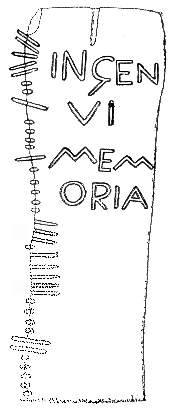
Latin Inscription
| Transcription | INGEN | VI | MEM | ORIA |
| Reading | INGENVI MEMORIA |
| Translation | The memoria of Ingenuus |
Ogham Inscription
| Ogham Text | ᚔᚌᚓᚅᚐᚃᚔᚋᚓᚋᚑᚏ (left edge, bottom-to-top) |
| Transcription | IGENAFIMEMOR |
| Reading | IGENAVI MEMOR |
| Translation | The memoria of Ingenuus |
Lewannick Stone II (LWNCK/2)
| Site | St Martin's Church, Lewannick, Cornwall. |
| NGR | SX 2760 8070 |
| Current Location | Inside the church, at the north end. |
| History | Discovered in 1894 by F. H. Nicholls, in two pieces, built into the walls of the north porch of the church. |
| Description | Pillar stone, now in two pieces, with one end missing, with Latin inscription running vertically, and Ogham inscriptions on the left and right edges. |
| Dimensions | 1.50 × 0.34 × 0.28 m. |
| Date | 400–799 (Okasha 1993) 500–566 (Thomas 1994) |
| Notes |
Viewed 27 August 2010. The stone is situated on the north side of the west end of the church. The Latin and Ogham inscriptions are both very clear and legible, and were highlighted with charcoal. The Ogham inscription on the right edge is only partially visible as the right side of the stone is against the wall. There are two unusual features of the inscriptions. Firstly, the Latin and Ogham inscriptions have the same orientation (both apparently reading vertically top-to-bottom or bottom-to-top). Secondly, the Ogham inscription is carved twice, once correctly as ULCAGNI (matching the VLCAGNI in the Latin inscription) and once incorrectly as UDSGQI (with the strokes of the letters L, C and N branching off to the wrong side of the stem, transforming them into the letters D, S and Q repectively). My hypothesis is that the stone was carved before it had been erected, by two different masons, one working on the Ogham inscription, and one working on the Latin inscription, and that they each thought a different end of the stone was the base. The Ogham inscription of the name Ulcagni was originally carved up what the mason assumed to be the left edge of the stone, as is normal, but because he accidentally carved the strokes of the letters L, C and N on the wrong side of the stem, he recarved the name correctly up the right edge of the stone; then when a different mason (who perhaps could not read Ogham) came to carve the Latin inscription, he assumed that the end of of the stone that the Ogham inscription starts at was the head of the stone, and carved his inscription down the stone from that end, with the result that if the stone is oriented with the Latin inscription reading downwards, as is normal, then the Ogham inscriptions appear to also read downwards (ULCAGNI down the left edge and UDSGQI down the right edge), which is abnormal. As the stone does not stand in situ, and is in quite bad condition (broken into two pieces), it is not evident which way up the stone originally stood, but my feeling is that it would have been more legible to have the Ogham inscriptions oriented correctly (UDSGQI reading up the left edge and ULCAGNI reading up the right edge) and the Latin inscription misoriented (reading vertically up from the base). This orientation is shown in the drawing from Macalister 1945 shown below. |
| References |
CISP LWNCK/2 NMR Monument No. 1402972 Macalister 1945 #467 Langdon & Allen 1895 No.2 |
|
Photo by BabelStone, 27 August 2010, CC-zero |
Macalister 1945 #467 |

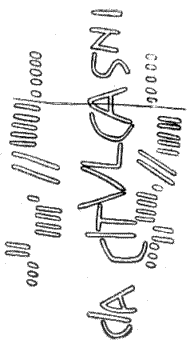
Latin Inscription
| Transcription | [--]CIA CITVLCAGNI |
| Reading | [HI]C IACIT VLCAGNI |
| Translation | Here lies Ulcagnus |
Ogham Inscription A
| Ogham Text | ᚒᚇᚄᚐᚌᚊᚔ (left edge, bottom-to-top) |
| Transcription | UDSAGQI |
| Reading | UDSAGQI (mistake for ULCAGNI) |
| Translation | Of Udsagcus (mistake for Of Ulcagnus) |
Ogham Inscription B
| Ogham Text | ᚒᚂᚉᚐᚌᚅᚔ (right edge, bottom-to-top) |
| Transcription | ULCAGNI |
| Reading | ULCAGNI |
| Translation | Of Ulcagnus |
 Lewannick Stone III (LWNCC/1)
| Site | 'Churchtown', Lewannick, Cornwall. |
| NGR | SX 2700 8000 |
| Current Location | Lost. |
| History | Discovered c.1912 by Frank H. Nicholls in a field south of Polyphant Quarry. Nicholls moved the stone to his garden, 'Moor View', in Lewannick [SX 2748 8082], but it was no longer in the garden in 1974 (and not known by the then owner, who had lived there since 1931). |
| Description | Pillar stone with inscribed marks along left edge and on the top of the front face. |
| Dimensions | Unknown. |
| Date | 400–700 (Thomas 1994) |
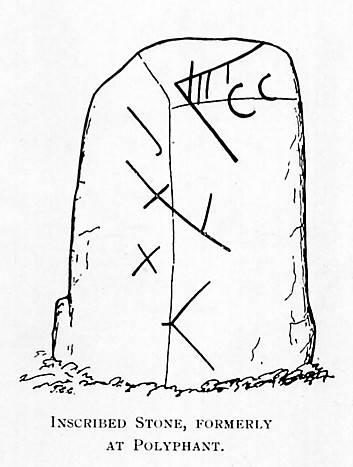
| Notes | This stone is listed in Thomas 1994 p.333, but with few details and no reading for the purported Ogham inscription. A drawing of the stone is given in Plate 3 of "On Some Antiquities at Lewannick, Cornwall" by Frank Nicholls and Henry Dewey in Journal of the Royal Institution of Cornwall vol. 19 part 1 (1912). From the drawing the marks do not appear to me to be an Ogham inscription. |
| References |
CISP : LWNCC/1 NMR Monument No. 436297 |
|
Journal of the Royal Institution of Cornwall No. LVIII Plate 3 |
St Kew Stone (STKEW/1)
| Site | St James' Church, St Kew, Cornwall. |
| NGR | SX 0215 7687 |
| Current Location | Inside the church, at the west end. |
| History | Discovered in 1924 by Rev. H. Dalton Jackson in the bed of a stream near St James' Church. |
| Description | Granite pillar stone, broken at both ends, with a vertical Latin inscription in a cartouche, and an Ogham inscription on the left edge. |
| Dimensions | 0.72 × 0.37 × 0.39 m. |
| Date | 400–799 (Okasha 1993) 550–599 (Thomas 1994) |
| Notes |
Viewed 27 August 2010. The stone is situated on the south side of the west end of the church, lying on its side on the floor. The Latin and Ogham inscriptions are both very clear and legible, and were highlighted with chalk. The Latin and Ogham inscriptions unusually have the same orientation, and so one of them must have been oriented contrary to normal practice when the stone was erect. I assume that the Ogham inscription would have been written top-to-bottom up the left edge, as is normal for short inscriptions, in which case the Latin inscription must have been written reading vertically up the stone, which is odd, but not as odd as a single line of Ogham being written top-to-bottom down one of the edges. |
| References |
CISP : STKEW/1 NMR Monument No. 431664 Macalister 1945 #484 |
|
Photo by BabelStone, 27 August 2010, CC-zero |
Macalister 1945 #484 |

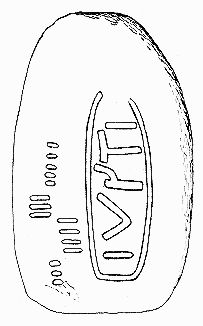
Latin Inscription
| Transcription | IVSTI |
| Reading | IVSTI |
| Translation | Of Iustus |
Ogham Inscription
| Ogham Text | ᚔᚒᚄᚈᚔ (left edge, bottom-to-top) |
| Transcription | [--]USTI |
| Reading | [I]USTI |
| Translation | Of Iustus |
Worthyvale Stone (WVALE/1)
| Local Name | King Arthur's stone |
| Site | Worthyvale, Minster, Cornwall. |
| NGR | SX 1092 8568 |
| Current Location | About 100 m upstream from Slaughter Bridge, on the left bank of the River Camel. Access via The Arthurian Centre (entrance fees apply). |
| History | First recorded by Richard Carew (1555–1620) in his Survey of Cornwall (1602) (see quotation below). William Borlase (1696–1772) records in his Antiquities of Cornwall (1754) that the stone was formerly used as a footbridge over the Camel, but Lady Falmouth moved the stone to a grotto at the foot of a nearby landscaped hill. By 1799 the stone was at its current position on the bank of the Camel (see The Gentleman's Magazine, and Historical Chronicle vol. 69 part 2 page 571). |
| Description | Large pillar stone with vertical Latin inscription in two lines, and Ogham inscription at the top end of the right edge. |
| Dimensions | 2.06 × 0.70 × 0.37 m. |
| Date | 400–799 (Okasha 1993) 533–566 (Thomas 1994) |
| Notes |
Viewed 27 August 2010. The stone is situated on the west bank of the River Camel, about 100 metres upstream from the B3314 road bridge at Slaughter Bridge. Access is only via the Arthurian Centre (Adults £3.50, Concessions £3.00, Family ticket £ 10.00): follow the trail to "King Arthur's Stone", which can be viewed from a wooden viewing platform above the river. The stone is lying flat, with the Latin inscription facing up, on an easily flooded shelf between the river and a rock cliff below the viewing platform. The Latin inscription is in good condition, and is quite legible, except for the middle two letters and last letter of "MAGARI", and the final letter of "IACIT". The Ogham inscription is very worn, and only the "I" of "LATINI" can still be easily recognised. Known as "King Arthur's stone". Richard Carew, Survey of Cornwall (1602) page 122b records : "Vpon the riuer of Camel, neere to Camelford, was that laſt diſmal battel ſtrooken betweene the noble king Arthur, and his treacherous nephew Mordred, wherein the one took his death, and the other his deaths wound. For teſtimony whereof, the olde folke thereabouts will ſhew you a ſtone, bearing Arthurs name, though now depraued to Atry." |
| References |
CISP : WVALE/1 NMR Monument No. 434115 Macalister 1945 #470 |
|
View of Ogham Stone from Viewing Platform
Photo by BabelStone, 27 August 2010, CC-zero |
Detail of Ogham Inscription
Photo by BabelStone, 27 August 2010, CC BY-SA 3.0 |
|
|
Macalister 1945 #470 |


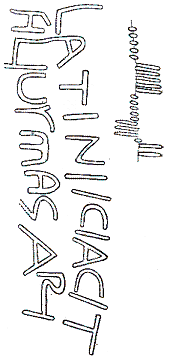
Latin Inscription
| Transcription | LATINIICIACIT | {FI}{LI}USMAGA{RI} |
| Reading | LATINI <H>IC IACIT FILIUS MAGARI |
| Translation | Of Latinus, here lies the son of Magarus |
| Notes | Macalister 1945 reads 'Magari'; Thomas 1994 reads 'Macari'. |
Ogham Inscription
| Ogham Text | ᚂᚐᚈᚔᚅᚔ (right edge, bottom-to-top) |
| Transcription | LA[--]NI |
| Reading | LA[TI]NI |
| Translation | Of Latinus |
Lancarffe Stone (LCARF/1)
| Site | Lancarffe House, Helland, Cornwall. |
| NGR | SX 0820 6900 |
| Current Location | Built into the wall of a summer house in the garden of Lancarffe House. |
| History | Discovered in 1912 by Mr Dunn in a stream near Lancarffe House. In 1928 a neighbour removed it to a garden in Bodmin without permission, but Mr Dunn recovered the stone, and built it into a garden wall for security. |
| Description | Pillar stone with vertical Latin inscription in two lines. |
| Dimensions | 1.87 × 0.25 × 0.04 m. |
| Date | 400–799 (Okasha 1993) 533–566 (Thomas 1994) |
| Notes | Marked as an Ogham stone on the Ordnance Survey Map of Britain in the Dark Ages, but no Ogham inscription is noted in the CISP database, or shown in the drawing of the inscription in Macalister 1945. |
| References |
CISP : LCARF/1 NMR Monument No. 431348 Macalister 1945 #457 |
|
Macalister 1945 #457 |
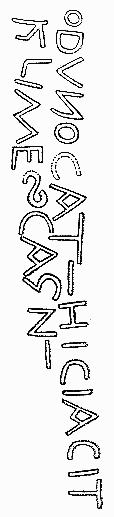
Latin Inscription
| Transcription | DVNOCATꟷHICIACIT | {FI}LIME{S}CAGNꟷ |
| Reading | DVNOCATI HIC IACIT FILI MESCAGNI |
| Translation | Of Dunocatus, here lies the son of Mescagnus |
| Notes | Thomas 1994 reads 'Mescagni'; Macalister 1945 reads 'Mercagni'. |
St Endellion Stone (SENDL/1)
| Local Name | Long Cross |
| Site | St Endellion, Cornwall. |
| NGR | SW 9890 7970 |
| Current Location | On a grass island at a junction about 1.5 km from St Endellion on the road to Port Quin. |
| History | First recorded in 1753 by James Tregeare in a manuscript account of the Parish of Endellion which was sent to William Borlase (1696–1772) for use in his anticipated but never published Parochial History of Cornwall. Sometime between 1821 and 1873 the stone was moved to Doyden Head near Port Quin, where it was subject to severe weathering, but in 1932 it was bought back to its original location by the road between Roscarrock and St Endellion Church, where it still stands. |
| Description | Granite pillar stone with a chi-rho cross at top, and a vertical Latin inscription in two lines. |
| Dimensions | 1.49 × 0.31 × 0.21 m. |
| Date | 500–799 (Okasha 1993) 566–599 (Thomas 1994) |
| Notes |
Viewed 27 August 2010. The stone is erected in the middle of a grass island at a junction on the road between St Endellion and Port Quin. The stone is heavily worn and covered with lichen, and I could see no trace of either the chi-rho cross or the Latin inscription. There was also no evidence of an Ogham inscription. Either I was looking at the wrong stone or its condition has deteriorated severely since it was examined by Okasha and Thomas in the early 1990s. The putative Ogham inscription is extremely doubtful: "There seemed to me to be faint and doubtful traces of Ogham—but nothing that could be regarded with any confidence" (Macalister 1945 p.457); "There is no sign of any ogham text today and in my view this can be disregarded" (Okasha 1993 p.23). |
| References |
CISP : SENDL/1 NMR Monument No. 430789 Macalister 1945 #478 |
|
Photo by BabelStone, 27 August 2010, CC BY-SA 3.0 |
Macalister 1945 #478 |

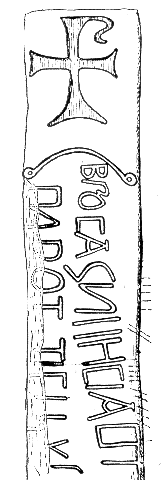
Latin Inscription
| Transcription | BROCAGNIIHCIACIT | [N^R]ADOTTIFILIVS |
| Reading | BROCAGNI IHC IACIT [N]ADOTTI FILIVS |
| Translation | Of Brocagnus, here lies the son of Nadottus (or Radottus) |
Ogham Inscription
| Ogham Text | ᚁᚏᚑᚊᚐᚌᚅᚔ (right edge, bottom-to-top) |
| Transcription | [--] |
| Reading | [BROCAGNI] |
| Translation | Of Brocagnus |
St Clement's Stone (SCLEM/1)
| Site | St Clement's Church, St Clement, Cornwall. |
| NGR | SW 8510 4390 |
| Current Location | In the churchyard, near the south door. |
| History | First recorded by William Borlase (1696–1772) in his Antiquities of Cornwall (1754), when it was being used as a gatepost in a field west of the church (later part of the vicarage garden). It was erected in the churchyard in 1938. |
| Description | Granite cross stone with a vertical Latin inscription. |
| Dimensions | 2.26 × 0.40 × 0.37 m. |
| Date | 500–799 (Okasha 1993) 500–533 (Thomas 1994) |
| Notes | The Ogham inscription is very doubtful. It is marked as an Ogham stone on the Ordnance Survey Map of Britain in the Dark Ages, and Macalister 1945 shows a reconstructed Ogham inscription along the damaged edges of the stone (where he presumably believed that the Ogham inscription had been deliberately excised), but the CISP database makes no mention of an Ogham inscription on this stone. |
| References |
CISP : SCLEM/1 NMR Monument No. 428762 Macalister 1945 #473 |
|
Macalister 1945 #473 |
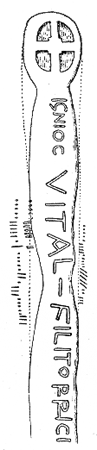
Latin Inscription A
| Transcription | VITALꟷFILITORRICI |
| Reading | VITALI FILI TORRICI |
| Translation | Of Vitalus, son of Torricus |
Latin Inscription B
| Transcription | IGNIOC |
| Reading | IGNIOC |
| Translation | Ignioc |
| Notes | Possibly "...igni" plus "oc" for "hic". |
Ogham Inscription
| Ogham Text | ᚃᚔᚈᚐᚂᚔᚋᚐᚊᚔ (left edge, bottom-to-top) |
| ᚈᚑᚏᚔᚉᚔ (right edge, bottom-to-top) | |
| Transcription | [--] | [--] |
| Reading | [VITALI MAQI TORICI] |
| Translation | Of Vitalus, son of Toricus |
Penwith Stone (PAUL/1)
| Site | Paul Parish Church, Paul, Penwith, Cornwall. |
| NGR | SW 4640 2713 |
| Current Location | In private ownership. |
| History | Found in a newly ploughed field near Paul parish church in November 2009. |
| Description | Fragment of a slate slab, with one end freshly broken. Two or three artificial stemlines are engraved parallel to each other on the surface of the stone. |
| Dimensions | 0.13 × 0.08 m. |
| Date | |
| Notes | The inscription is very incomplete, with just fragments of five or six letters remaining. The inscription on the flat surface of the stone is very unusual, although it is normal in Pictish Ogham inscriptions from Scotland to be carved on the surface of the stone, and an Ogham inscription carved on the flat surface of a piece of slate that is datable on archaeological evidence to 540–650 was discovered on the Isle of Man in 2007 (see Speke Farm Keeill Stone). |
| References | BabelStone (15 November 2009) |
Photo courtesy of the stone's finder |
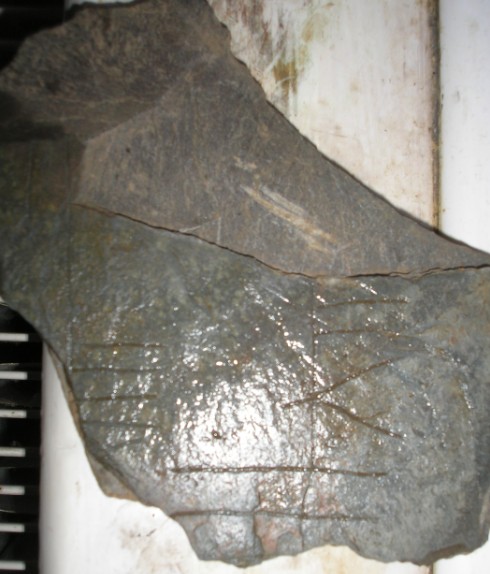
|
Detail of left stemline (click for overlay)
Photo courtesy of the stone's finder |
Detail of right stemline (click for overlay)
Photo courtesy of the stone's finder |
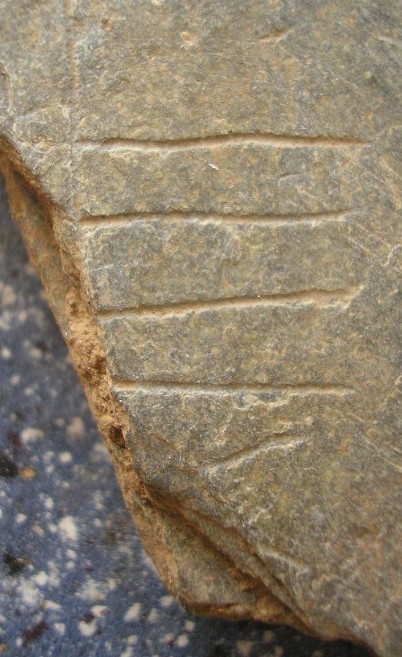
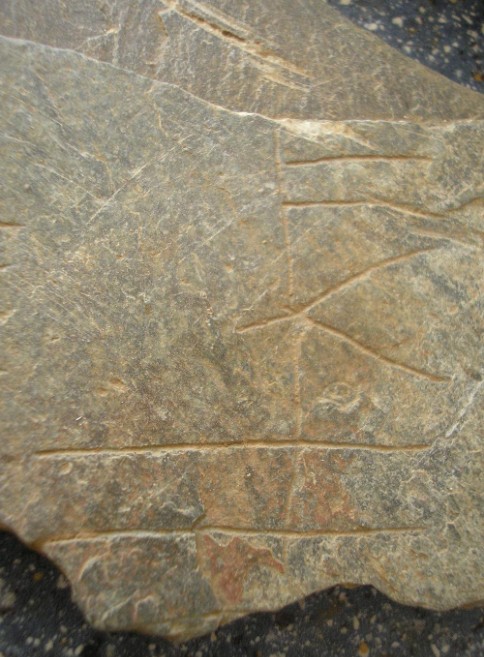
Ogham Inscription
| Ogham Text | ᚘᚄ (left stemline) |
| ᚒᚘᚂ (right stemline) | |
| Transcription | [--][P]S | [U!]P[L!][--] |
| Reading | |
| Translation | |
| Notes | Transcription by Andrew West. There is possibly a third stemline on the top left, with a single letter A. The inscription is too fragmentary to attempt a definite reading, but the three vowel strokes of the first letter on the right stemline could conceivably be the remains of the letter i from the Primitive Irish word maqi "son of", and the following two letters could be the start of a Latin name beginning with Pl..., i.e. [--] [MAQ]I PL[--] = "..., son of Pl[...us]". |
Devon
Roborough Down Stone (TVST3/1)
| Site | Roborough Down, Buckland Monachorum, Devon. |
| NGR | SX 4900 6930 |
| Current Location | Tavistock Vicarage Garden. |
| History | Discovered by Rev. E. A. Bray in 1834, when it was being used as a gatepost to a field on Roborough Down. The landowner refused Bray's request to remove it to his garden at Tavistock vicarage, but in 1868 (Francis Charles) Hastings Russell (1819–1891) had the stone taken to Tavistock Vicarage Garden. |
| Description | Pillar stone with a vertical Latin inscription in three lines, and an Ogham inscription on the left edge. |
| Dimensions | 1.52 × 0.43 × 0.30 m. |
| Date | 400–799 (Okasha 1993) 533–566 (Thomas 1994) |
| Notes | Viewed 14 August 2012. Located in the private garden of the vicarage at Tavistock, together with TVST1/1 (photo) and TVST2/1 (photo). Viewed by kind permission of Rev. Michael Brierley. The Latin inscription is extremely weathered, and at first sight there appears to be no inscription at all on the front of the stone. However, with a little imagination and prior knowledge of what is supposed to be inscribed there, most of the letters can just about be recognised, although I would have found it impossible to make a reading unaided. The Ogham inscription on the left edge is in much better condition, and the last five letters of "ENABARR" can still be recognised quite easily (the letters "ABA" are particularly distinct on close examination). |
| References |
CISP : TVST3/1 NMR Monument No. 437968 Macalister 1945 #488 Ferguson 1887 #196 |
|
Front of Ogham Stone
Photo by BabelStone, 14 August 2012, CC BY-SA 3.0 |
Left Side of Ogham Stone
Photo by BabelStone, 14 August 2012, CC BY-SA 3.0 |
|
|
Macalister 1945 #488 |


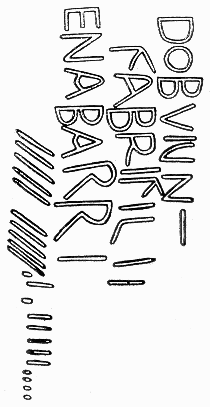
Latin Inscription
| Transcription | DOBVNNꟷ | FABRIFILII | ENABARRI |
| Reading | DOBVNNI FABRI FILII ENABARRI |
| Translation | Of Dobunnus the smith, son of Enabarrus |
Ogham Inscription
| Ogham Text | ᚓᚅᚐᚁᚐᚏᚏ (left edge, bottom-to-top) |
| Transcription | ENABARR |
| Reading | ENABARR |
| Translation | Enabarr |
Fardel Stone (FARDL/1)
| Site | Fardel Farm, Cornwood, Devon. |
| NGR | SX 6110 5740 |
| Current Location | British Museum [1861,0209.1] (G41/s6). |
| History | Discovered by Rev. Samuel Pearse of Cadleigh, who as a boy in the late 18th century had noticed the inscribed stone in use as a part of a culvert over the Fardel Brook crossing the road between Ivybridge and Fardel. In about 1860 Pearse had the stone removed to the farmyard at Fardel, and in 1861 the farm's owner, Captain Pode, donated the stone to the British Museum. |
| Description | Pillar stone in red sandstone with a vertical Latin inscription and an Ogham inscription on the left and right edges. |
| Dimensions | 1.68 × 0.87 × 0.25 m. |
| Date | 400–799 (Okasha 1993) 500–550 (Thomas 1994) |
| Notes | Viewed 14 August 2012, on display at the British Museum. |
| References |
CISP : FARDL/1 NMR Monument No. 441290 Macalister 1945 #489 Brash 1869 #164 Ferguson 1887 #197 |
|
Front of Ogham Stone
Photo by BabelStone, 24 September 2016, CC BY-SA 3.0 |
Back of Ogham Stone
Photo by BabelStone, 24 September 2016, CC BY-SA 3.0 |
|
|
Left Side of Ogham Stone
Photo by BabelStone, 24 September 2016, CC BY-SA 3.0 |
Right Side of Ogham Stone
Photo by BabelStone, 24 September 2016, CC BY-SA 3.0 |
|
|
Macalister 1945 #489 |


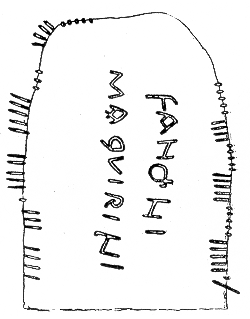


Latin Inscription A (front)
| Transcription | FANONI | MAQVIRINI |
| Reading | FANONI MAQVI RINI |
| Translation | Of Fanonus, son of Rinus |
Latin Inscription B (back)
| Transcription | SAGRANVI |
| Reading | SAGRANVI |
| Translation | Of Sagranuus |
Ogham Inscription
| Ogham Text | ᚄᚃᚐᚊᚊᚒᚉᚔ (left edge, bottom-to-top) |
| ᚋᚐᚊᚔᚊᚔᚉᚔ (right edge, bottom-to-top) | |
| Transcription | SFAQQUCI | MAQIQICI |
| Reading | S<A>FAQQUCI MAQI QICI |
| Translation | Of Safaqqucus, son of Qicus |
| Notes | These may also be two independent inscriptions, SAFAQQUCI "Of Safaqqucus" and MAQIQICI "Of Maqiqicus" or "Of the son of Qicus". |
Brendon Stone (BRNDN/1)
| Site | Brendon, Devon. |
| NGR | SS 7361 4606 |
| Current Location | Set into the base of a field wall on the north side of the track from Cheriton to Hoaroak. |
| History | Identified as an Ogham stone by "Pearce" (Susan M. Pearce, author of The Kingdom of Dumnonia: studies in history and tradition in south-western Britain, A.D. 350-1150 (1978) ?). |
| Description | Large stone with linear scratches on its south face and west edge. |
| Dimensions | 1.10 × 0.70 × 0.20 m. |
| Date | |
| Notes | There are linear scratches on two edges of this stone, but these are probably not an Ogham inscription, but marks made by ploughing before the stone was built into the wall. |
| References | NMR Monument No. 926316 |
References
- CISP : Celtic Inscribed Stones Project. Department of History and the Institute of Archaeology, University College London.
- NMR : National Monuments Records. English Heritage.
- Brash 1869 : Richard Rolt Brash, "The Ogham Inscribed Stones of Wales"; in Archæologia Cambrensis 3rd series vol.15 (1869) pages 148–167.
- Ferguson 1887 : Samuel Ferguson, Ogham Inscriptions in Ireland, Wales, and Scotland. Edinburgh, 1887.
- Langdon & Allen 1895 : A. G. Langdon and J. R. Allen, "Catalogue of the Early Christian Inscribed Monuments in Cornwall"; Archaeologia Cambrensis 5th series vol.12 (1895) pages 50–60.
- Macalister 1945 : R. A. S. Macalister, Corpus Inscriptionum Insularum Celticarum Vol. I. Dublin: Stationery Office, 1945.
- Okasha 1993 : Elisabeth Okasha, Corpus of Early Christian Inscribed Stones of South-west Britain. Leicester: Leicester University Press, 1993.
- Thomas 1994 : Charles Thomas, And Shall These Mute Stones Speak? Post-Roman Inscriptions in Western Britain. Cardiff, 1994.
Key
The following conventions are used in the transcription of Latin, Runic and Ogham inscriptions :
- [X] = letter X assumed but it is unclear or uncertain
- [X^Y] = letter is uncertain but may be either X or Y
- [X!] = Ogham letter is incomplete, and may be X or any letter from the same series as X with more strokes than X (e.g. [T!] is equivalent to [T^C^Q], and [A!] is equivalemt to [A^O^U^E^I])
- [-] = single missing or obliterated letter
- [--] = unknown number of missing or obliterated letters
- {X} = unusual glyph form of letter X (description on mouseover)
- {XY} = ligatured form of letters X and Y
- (X) = letter X in the inscription is extraneous and should be omitted in the reading
- <X> = letter X is missing in the insciption and should be added in the reading
| Letter | Name | Transcription | Notes |
|---|---|---|---|
| ᚁ | Beith | B | |
| ᚂ | Luis | L | |
| ᚃ | Fearn | F | Read as F or V. |
| ᚄ | Sail | S | |
| ᚅ | Nion | N | |
| ᚆ | Uath | H | |
| ᚇ | Dair | D | Variants include 'Rabbit-eared D'. |
| ᚈ | Tinne | T | |
| ᚉ | Coll | C | |
| ᚊ | Ceirt | Q | |
| ᚋ | Muin | M | |
| ᚌ | Gort | G | |
| ᚍ | nGéadal | W | Read as Ng or Gw. |
| ᚎ | Straif | Z | Read as Z or St. |
| ᚏ | Ruis | R | Double R is occasionally written as a crosshatched ligature. |
| ᚐ | Ailm | A | Variants include 'Hammerhead A' and 'S-shaped A'. |
| ᚑ | Onn | O | |
| ᚒ | Úr | U | |
| ᚓ | Eadhadh | E | |
| ᚔ | Iodhadh | I | |
| ᚕ | Eabhadh | X | Read as É or K. |
| ᚖ | Ór | Ó | |
| ᚗ | Uilleann | Ú | |
| ᚘ | Ifin | P | Written as a single cross under the stemline in epigraphic texts. |
| ᚙ | Eamhancholl | Not found in epigraphic texts. |
Ogham Fonts
This page is best viewed if the set of 12 BabelStone Ogham fonts are installed on your system.
In order to see the Latin Epigraphic Letter Sideways I (ꟷ) it is recommended to install the BabelStone Roman font or the Doulos SIL font (version 5.000 or later).
Revised: 2016-09-24
Index of BabelStone Blog Posts